
'The West Asia or the Gulf crisis has shown that what we develop as national infrastructure when things are not as bad as they could be, we forget to plan for adversities.'
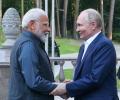
The Indian government is dealing with the matter having in mind the national interests of this country in the first place, he said.

India's crude oil imports have jumped 5.3 per cent to 51.928 million tonnes in the first seven months of the current fiscal as against 49.289 million tonnes in the same period last fiscal.

Analysts predict continued volatility in Indian equity markets due to domestic macroeconomic data, F&O expiry, global developments including US tariff policies, and geopolitical tensions.

The Indian central government has reduced its total expenditure by approximately 60,000 crore in FY26, below its revised estimate, to successfully achieve the fiscal deficit target of 4.4 per cent of gross domestic product (GDP), according to the latest data from the Controller General of Accounts (CGA).

India's economy registered a robust 7.7 per cent growth in the fiscal year 2025-26, an increase from 7.1 per cent in the previous year, with the January-March quarter alone seeing a 7.8 per cent expansion.

Indian stock markets recovered from early losses to close higher, driven by value buying in IT and banking shares and a rebound in the rupee.

Two India-bound LPG tankers have crossed the Strait of Hormuz amid heightened tensions in the region, while an India-flagged vessel sank after being hit near the strategic shipping corridor.

In the present hyper-connected world, there are many domestic and global factors that affect financial markets. Of them, the most powerful and often least predictable are geopolitical events, which often boil down to one diplomatic headline.
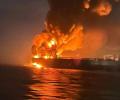
Ukraine claimed responsibility after explosions hit the vessels on Friday and Saturday.

United States President Donald Trump on Wednesday said Prime Minister Narendra Modi had assured him that India would stop purchasing oil from Russia, describing it as "a big step" in efforts to increase global pressure on Moscow.

Indian equity investors experienced a significant loss of 16.32 lakh crore due to a two-day stock market decline fueled by escalating geopolitical tensions involving the US, Israel, and Iran.

Escalating geopolitical tensions in West Asia are beginning to disrupt India's automotive supply chain, leading to rising commodity prices, logistics bottlenecks, material shortages, and pressure on consumer demand, with two-wheeler makers already raising prices.

Indian benchmark indices Sensex and Nifty experienced a decline in early trade, mirroring weak global market trends and persistent outflows from foreign institutional investors (FIIs), exacerbated by ongoing geopolitical uncertainties in West Asia.
The Opec output has fallen slightly in November at around 29 million barrels a day since last August.

Indian benchmark indices Sensex and Nifty experienced a significant downturn in early trade, ending a five-day rally, primarily due to heavy selling in IT firms following a revenue growth guidance cut by global consulting giant Accenture.

'The US was well aware of the nationality of the seafarers on board the vessels. It was not hidden. The nationality of those aboard a merchant ship is known to all the ports.' 'So, why did US shoot a missile that resulted in the deaths of the Indian mariners?'
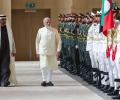
Prime Minister Narendra Modi has offered India's support to bring peace to West Asia during talks with UAE President Sheikh Mohamed bin Zayed Al Nahyan. Both countries signed agreements to strengthen strategic collaborations in energy and defence.

Falling debris from an intercepted Iranian drone caused a 'limited fire' at Saudi Aramco's Ras Tanura refining facility in Saudi Arabia, Saudi Defence Ministry spokesperson Turki Al-Maliki said, according to Al Arabiya.

India's fiscal deficit is projected to reach 4.5 per cent of GDP for the current fiscal year, exceeding the budgeted target, as the government's policy responses to the West Asia conflict are expected to strain public finances, according to research firm BMI.

Notwithstanding the economic complementarities and the host of agreements for deepening economic relation on a host of areas, both sides share common viewpoints on the foreign policy domain and seek common grounds to serve as a counterweight to China, notes Dr Rajaram Panda.

China is slowing down, Europe is barely afloat and the US is meeting a larger chunk of its own demand.

US President Donald Trump indicated the possibility of further military operations against Iran's Kharg Island, a key oil export hub, claiming previous strikes had significantly damaged its infrastructure.

Markets will look for clear guidance on how the MPC interprets the uncertainty and what it implies for the future course of monetary policy, points out Rajeswari Sengupta.

A prolonged supply shock can transmit to lower incomes, and dampen confidence and sentiment, warns Aditi Nayar, chief economist, head-research and outreach, ICRA.

The government has to take a call on reducing or retaining the excise rate.

The rupee appreciated 53 paise to close at 89.67 against the US dollar on Friday, supported by corporate dollar inflows and easing crude oil prices. Forex traders said a positive trend in domestic equities and Brent crude oil prices hovering near $59 per barrel supported the domestic unit at lower levels.

As the rupee weakens, wealthy families are accelerating investments in global assets.
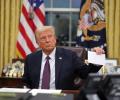
US President Donald Trump claimed India will stop buying oil from Russia, while also stating China will cut back substantially. He also discussed the conflict between India and Pakistan, reiterating his claim of helping settle the conflict.

India summoned the Iranian envoy after two Indian vessels had to reverse course in the Strait of Hormuz following an incident of firing by Iran's Revolutionary Guards.

'Once the currency goes out of the hand, then possibly your major challenge is that it will not come back.'

India's eight core infrastructure sectors experienced a slowdown in production growth, reaching a two-month low of 4% in January. Crude oil and natural gas output declined, while refinery products remained flat. Overall growth for the April-January period was also lower compared to the previous fiscal year.

Using an expletive in his post on X, Navarro said, "Fact: India didn't buy Russian oil in large quantities before Russia invaded Ukraine. It's blood money and people are dying."

Gold has emerged as the most stable asset during episodes of geopolitical stress, and crude oil has been more sensitive than others when it comes to regional conflicts and sanctions, according to a report in the Reserve Bank of India's (RBI's) monthly bulletin. Silver and the United States Treasury have showed moderate reactions.

Indian benchmark indices Sensex and Nifty closed lower for the second consecutive day, driven by investor caution over conflicting geopolitical signals from West Asia and fresh foreign institutional investor (FII) outflows.

Trump's remarks marks one of the most direct rebukes yet from Washington to its allies over their refusal to support US-led military operations in Iran and over the energy crisis triggered by disruptions in the Persian Gulf.

The government has assured citizens that there is no need to panic book LPG cylinders, as uninterrupted supply to households is being ensured despite the ongoing conflict in West Asia.

Despite ongoing tensions in West Asia, the successful arrival of the LPG carrier 'Nanda Devi' in Gujarat ensures a steady supply of liquefied petroleum gas to India, highlighting the country's efforts to secure its energy needs.

'Markets never fully lose hope. But an important shift could come if the Strait remains closed -- moving from high prices to no prices.'
Chinese stock markets suffered their biggest single-day drop since the global financial crisis.
